
THE ACCESS GUIDE · MONTREAL
Furniture and access: the measurements that keep your Montreal move moving
Your sofa can fit in the living room and still get stuck at the entrance. We explain how to measure your furniture, identify difficult passages and prepare the right questions before your move.
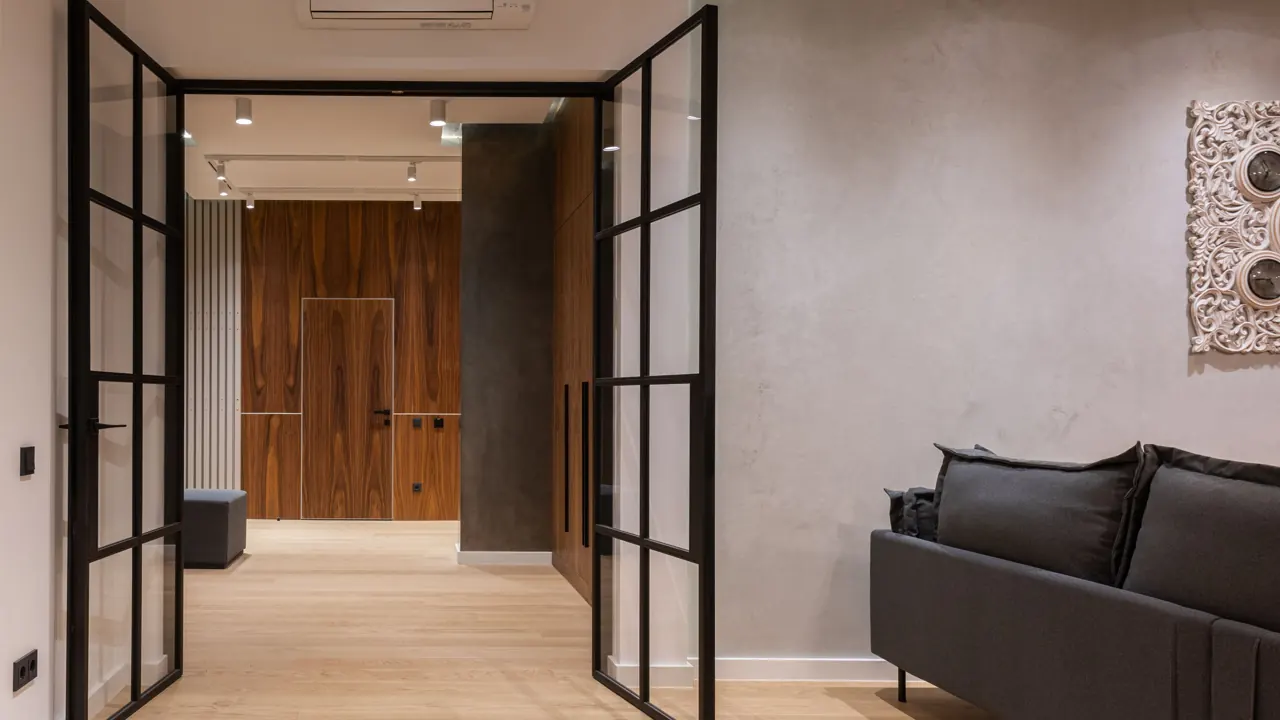
Before the truck arrives, walk the route your furniture will take
Your sofa may fit perfectly in the living room and still get stuck at the entrance. At Déménagement ALEX, we recommend checking the access as soon as you can visit your next home. When you plan your Montreal move, send us the dimensions of your bulky furniture and the details of both addresses. A photograph with measurements tells us more than the words “narrow staircase.”
Start with two separate routes: from the furniture’s current position to the loading point, then from the unloading point to its new room. Do not stop at the main entrance. A bedroom doorway, a vestibule or the turn just before the living room can be the tightest part of the journey.
We suggest making this first inspection without carrying anything. Take your phone and a notebook, and number the passages in order: entrance, hallway, staircase, landing, elevator and room doorway. You can then tell us exactly where a difficulty occurs and find the matching photograph while we discuss it.
Leave space for information you do not have yet. If you cannot enter the basement or inspect the service elevator, mark that point as unconfirmed. We would rather work from an honest question than an estimated dimension that looks certain. Our moving preparation guide can help you fit this inspection into the rest of your departure plan.
Measure your furniture as it will actually travel
For each bulky item, record its width, depth and height at the furthest points. Include arms, the backrest, handles and projecting tops. Keep the same unit throughout your worksheet, such as centimetres, and write it beside the figures. This prevents confusion when a relative or a member of our team checks the measurements with you.
The shape matters as much as the numbers. An angled back, a curved base and a rigid cabinet behave differently in a confined passage. Take front, side and rear photographs. If you have the model reference or assembly instructions, include them so we can understand which parts are fixed and which may separate.
Next, identify the components that are genuinely removable. Unscrewing legs or separating independent modules can reduce the size when the manufacturer provides for that operation. Removing a cushion does not necessarily reduce the height of the frame. Record the assembled dimensions, followed by those of each part you expect to transport separately.
Clarify who will perform the work. If you need help with furniture disassembly and reassembly, identify the model, the requested tasks and any missing or damaged fittings. We can discuss the scope with you before you rely on dismantling as the solution. Do not assume that every piece of furniture can be taken apart repeatedly.
For a second-hand purchase, ask the seller for current measurements. The specification of a similar model or the dimensions of the original packaging are not enough. Finally, check the furniture’s footprint in the destination room, allowing for doors, drawers and circulation. A reclining chair also needs space in its open position, not just room to cross the threshold.
Doorways and turns: look at the space on both sides
Measure the clear opening with the door actually open, rather than only the width of its frame. Look for handles, the door leaf, a closer or anything else projecting into the passage. Record the available height too. Your measurements should describe the configuration you are authorized to use on moving day.
We also need to understand the space immediately before and after the opening. A wall directly opposite may restrict how a long object can be turned upright. An entrance in a corner offers less room than one in the middle of a wall. In a vestibule with two successive doors, the whole transition matters.
To show us that transition, record a slow video beginning far enough before the obstacle. Include the floor, ceiling, doors and next change of direction, then continue beyond the turn. A simple sketch showing which way each door opens is useful. You are documenting the setting, rather than trying to work out a lifting technique.
The RH furniture measuring guide also draws attention to clearance around doorways and changes of direction. We include it as a supplementary visual resource. It cannot replace an assessment of your particular item, its shape and the actual route through your home.
On your staircase, the landing deserves its own measurements
Whether your stairs are inside or outside, we need to understand their actual layout. The neighbourhood name and floor number do not describe a landing. Even if your furniture has used those stairs before, check how it originally arrived: assembled, in separate parts or through another entrance.
Record the clear width at the restrictive points, the landing dimensions and the available headroom along the route. Show handrails, posts and changes of slope in your photographs. A straight flight may look promising but end in a tight turn. The underside of the flight above may reduce the space precisely where the furniture needs to change orientation.
Take measurements from a stable position. Do not lean over an open edge, move a heavy item as a test or remove a railing to gain a few centimetres. If a measurement is difficult to obtain safely, tell us. We can clarify what information or assessment is needed instead of encouraging an improvised trial.
Before departure, inspect the route again. Construction work, a replaced door or stored materials may have changed the situation since your visit. Tell us about those differences before the truck arrives. For unusually heavy or awkward objects, describe the item and access together when discussing heavy-item moving requirements; weight alone does not describe the job.
Your elevator must be accessible and available at the right time
An elevator is helpful information, but its presence does not settle the access question. Ask your building manager which elevator is authorized for the move and which entrance you must use. Record the doorway opening, the usable cabin dimensions and the clearance in front of it.
Then follow the route leading to the elevator. A large cabin may sit beyond a narrow corridor or a difficult service door. Show us that connection in your video. We can examine the whole journey instead of relying on a photograph of the cabin alone.
Confirm the reservation, the required protective measures and the building’s access procedure. Send us those instructions and the elevator’s stated capacity information. Do not borrow the rules of another building or assume that an elevator will remain available throughout your entire moving window. Departure and delivery may have different arrangements.
IKEA Canada’s home-delivery terms, available here in French, also address suitable access and elevator reservations for the relevant delivery window. Those are that supplier’s terms, not the conditions of Déménagement ALEX. The practical distinction is useful for your preparation: favourable dimensions do not replace confirmed access.
Build a short worksheet we can review together
You do not need to send us fifty unexplained photographs. Give each item a name and each passage a number. Keep the departure and arrival addresses separate. We can then find the correct landing or sofa module quickly when reviewing your request with you.
| Item or passage | What to record |
|---|---|
| Bulky furniture | Name, known model, overall dimensions, confirmed removable parts and photographs. |
| Door or corridor | Clear opening, available height, obstacles and space on both sides. |
| Stairs and landing | Clear width, headroom, landing dimensions, turns, rails and posts. |
| Elevator | Authorized elevator, opening, cabin, clearance, instructions and reservation. |
| Coordination | Exact entrance, contact person, confirmed access times and unresolved questions. |
Add a short message explaining which item worries you, which passage looks difficult and which answer you are still waiting for. Keep personal documents, access codes and neighbours’ faces out of the images. We can agree with you on an appropriate way to share any confidential information needed for the move.
If someone helps you, read the figures back together, naming the passage and unit. Date the worksheet. When a measurement changes, send the complete corrected version and point out the difference. This helps us work from one coherent record rather than several contradictory messages spread across a conversation.
Two illustrative examples: what your measurements help us decide
Consider a completely fictional example. Your sofa is 214 cm long, 96 cm deep and 88 cm high. The destination door has a clear width of 82 cm. We cannot confirm passage by comparing only 96 and 82: the backrest shape, feet, height and vestibule clearance still matter. Send us the measurements and photographs before confirming transport of that item.
In another fictional example, you are moving a modular sofa. Its largest section appears compatible with the reserved elevator. Your video, however, shows a bent corridor between the loading area and the cabin. We ask you to document that turn. You avoid confusing two different questions: whether the module fits inside the elevator and whether it can reach its door.
These examples illustrate our preparation process. Your measurements help us ask the right questions while there is still time to explore options. They do not authorize you to attempt a difficult manoeuvre with a heavy load, and they are not a remote guarantee that furniture will pass.
If the furniture looks blocked, discuss alternatives before loading
First, establish what can actually be dismantled. Find the instructions for the correct model and clarify who will take it apart, protect it and reassemble it. Ask for the selected tasks to be described in your request or quote. Tell us about weakened sections and known repairs before handling begins.
Protection also belongs in this discussion. A plan based on an unprotected furniture measurement should not assume that every available centimetre can be used during handling. Our packing and furniture protection services page helps you identify the assistance you want us to assess. Confirm the agreed work rather than treating it as automatically included.
Another entrance may be worth examining, but you must confirm permission and check the entire alternative route. A wider door can lead to a less favourable staircase. Do not assume that a neighbouring yard or service entrance is available. Ask the relevant owner or manager before making it part of your plan.
If no ordinary route is confirmed, discuss a fallback before loading the item. You might leave it out of the move, arrange another authorized destination or seek a specialist assessment. If storage becomes part of that decision, review our practical storage guide and confirm the receiving arrangements. A window or balcony operation needs a specific assessment; this article does not offer an improvised method.
Ask what changes in the price if extra disassembly, a different entrance or a second destination becomes necessary. Our guide to avoiding unexpected moving fees helps you prepare those questions. Keep the written answers with your inventory so that we share the same understanding of the job.
On moving day, show us the important points before work starts
When we arrive, identify the items you flagged and the passages you documented. Keep your worksheet handy. You can show us the turn that concerns you, the authorized entrance or the component intended for removal without searching through an unlabelled collection of photographs.
Clear the route where you can do so safely. Boxes, loose rugs and personal belongings should not create a new obstacle in the vestibule. For doors and protective measures, follow your building’s instructions and the agreed arrangements. Having one person available for decisions will make communication with us easier.
If an access condition has changed, tell us before proceeding. We would rather discuss the situation with you while the item remains in a safe position. That is the purpose of your preparation: replacing a pressured decision at a doorway with a clear conversation at the right moment.
Your questions before moving bulky furniture
Is the door width enough to know whether my sofa fits?
No. We also need to understand the furniture’s shape, its other dimensions, the clearance and the turns. Send your measurements and route photographs. If information is missing, we can explain what needs checking before reaching a conclusion.
Which pieces should I measure first?
Start with long, tall, rigid or particularly bulky items. A smaller piece can also be difficult in a very restricted passage. If you are unsure about an item, include it rather than leaving it out just because it seems light.
Can photographs replace measurements?
We recommend providing both. Perspective can distort a width or depth, while a number cannot show every feature of a passage. If you cannot obtain a measurement safely, clearly mark it as needing confirmation instead of guessing.
Does removing the feet guarantee that furniture will pass?
No. It may reduce one dimension without solving a turn or another obstacle. Check the instructions and send the resulting dimensions. Also confirm who performs disassembly and reassembly; those tasks should not be assumed included in every booking.
What if I cannot visit my future apartment?
Ask the owner, manager or an authorized visitor for measurements. Tell us which details remain unknown. A listing photograph or marketing floor plan can help explain the layout, but it does not confirm the actual clear openings.
My furniture has used these stairs before. Should I check again?
Yes. It may have arrived dismantled, through another entrance or before a building alteration. Explain what you know about its arrival and verify current conditions. We can then prepare the next move with more reliable information.